

Calls grow at home for leader of the world’s largest Muslim country to distance from Washington amid US-Israel war on Iran.
Indonesia protests: President under pressure over ties to United States
Share
Save
When the United States-Israeli attack on Iran was launched last weekend, an unexpected peace broker stepped forward in the form of Indonesian President Prabowo Subianto, leader of the world’s largest Muslim country.
The Indonesian Ministry of Foreign Affairs announced on social media: “Indonesia calls on all parties to exercise restraint and to prioritize dialogue and diplomacy.
“If agreed by both parties, the President of Indonesia is prepared to travel to Tehran to carry out mediation,” it said.
But President Prabowo’s offer to help mediate between the sides has provoked debate across Indonesia, coming at a time of increased criticism of his approach to foreign policy and warm ties with the Trump administration.
“I’m puzzled as to why this idea wasn’t vetted before being made public,” Dino Patti Djalal, Indonesia’s former deputy foreign minister and former ambassador to the US, said in a statement on Instagram.
“It is highly unrealistic,” Djalal said.
Others agreed, adding that the offer could further alienate Indonesians already wary of the president’s perceived cordial relationship with US President Donald Trump.
“It is clear that any negotiations between Iran and the US have completely ended, so to propose this seems to be not reading the room,” Ian Wilson, a lecturer in politics and security studies at Murdoch University in Perth, Australia, told Al Jazeera.
“Domestically, people are likely to interpret this as a further alignment with Trump and therefore Netanyahu,” Wilson said.
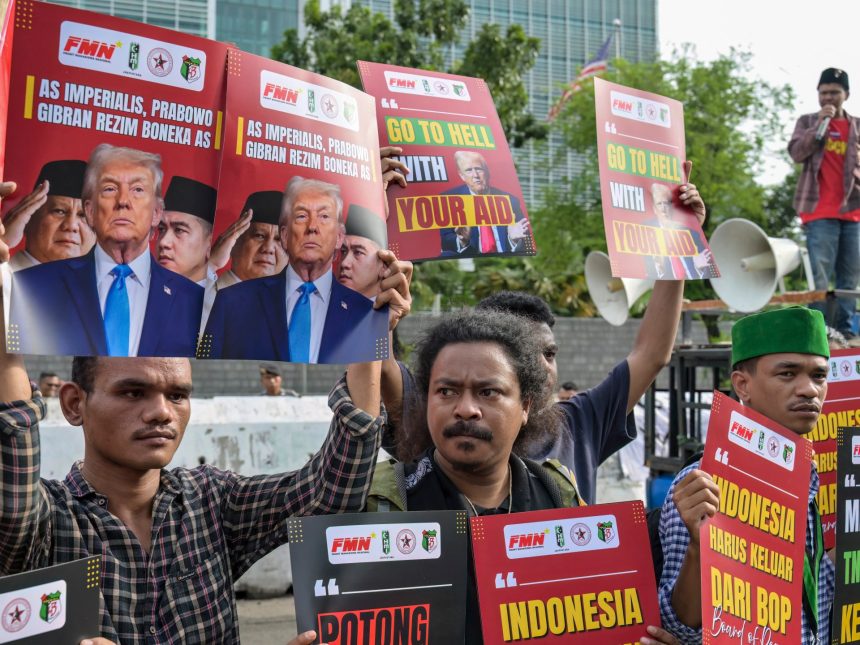
In recent months, Prabowo has faced domestic scrutiny after volunteering to deploy 8,000 Indonesian troops to Gaza as part of an International Stabilization Force under the umbrella of Trump’s Board of Peace (BOP) – a so-called “international peacekeeping” organisation of which Israel is also a member.
Indonesia does not have any formal diplomatic relations with Israel, and has long supported an independent Palestine.
Joining Trump’s board and offering to participate in the US president’s plan for Gaza has not gone down well domestically.
“Indonesia is being used to legitimise the BOP’s dystopian plan to divide Gaza into quadrants and bypass the role of the United Nations,” Wilson said.
“For Indonesia to be involved fundamentally betrays its longstanding tradition of being a principled voice for the Global South, and its approach to foreign policy, which historically has been deeply respected,” he said.
Indonesia was one of the founding members of the Non-Aligned Movement during the Cold War, which saw the country adhere to a “bebas-aktif” or “independent and active” approach to foreign policy for decades, avoiding the major power blocs while actively working for peace and the national interest.
Over the years, this has included Indonesia’s attempts to broker peace in a number of global conflicts, including the Russia-Ukraine war.
But Indonesia’s membership of Trump’s Board of Peace amid Israel’s genocide in Gaza, and now the joint US-Israeli attack on Iran, could present an unprecedented test for Prabowo’s approach to foreign policy, experts said.
“The Foreign Ministry’s statement on the attack was regrettably naive,” said Sarbini Abdul Murad, director of the humanitarian group, Indonesia for Peace and Humanity.
While the president had offered to mediate, little was said about the killing of Iran’s Supreme Leader Ayatollah Ali Khamenei, Sarbini said, pointing out that neighbouring Malaysia’s Prime Minister Anwar Ibrahim had condemned the assassination of Khamenei by US and Israeli forces.
“The death of Ali Khamenei went unanswered,” he said
“Indonesia is at a crossroads in its foreign policy,” Sarbini added.
Indonesia’s Minister of Foreign Affairs Sugiono – who, like many Indonesians, uses a single name – said in a post on social media on Wednesday that Prabowo had expressed his deepest condolences to Iranian President Masoud Pezehkian on “the passing” of Khamenei.
While Indonesia has entrenched support for Palestine, the relationship with Iran is rather more complicated.
About 87 percent of the country’s 270 million population follows Islam, and the majority of Indonesia’s Muslims are Sunni.
Iran has the world’s largest Shia population, which follows a different branch of Islamic theology with differing views on aspects of Islamic political theory and history.
“Previously, there was anti-Shia sentiment among Sunni in Indonesia,” said Made Supriatma, a visiting fellow with the Indonesia Studies Programme at the ISEAS – Yusof Ishak Institute in Singapore.
“However, many Indonesians sympathise with Iran. This is not always out of solidarity with fellow Muslims, but rather because of anti-Israel and anti-American sentiment, which has long been high,” Supriatma said.
Though many Indonesians support Iran, it is not on the same scale as Palestine, when thousands of people attended demonstrations across Indonesia at the start of the genocidal war on Gaza. Protests against the current war on Iran are mostly confined to “chatter on social media”, Supriatma said.
Many Indonesians have expressed sympathy for Iran and anger towards the US for what they see as an unprovoked attack on Iran, said Yohanes Sulaiman, a lecturer in politics, security and foreign policy at Indonesia’s Universitas Jenderal Achmad Yani.
But many are likely unaware of what is taking place inside Iran, including the “anti-regime protests” that recently shook the country, Sulaiman said.
Indonesian housewife Arisha Ishana said she had indeed not heard about any demonstrations in Iran. Despite this, Ishana told Al Jazeera that she supported Iran in the conflict “because they are fellow Muslims”.
Ramadhan, a barista, said he supported Iran’s right to defend itself.
“This conflict was not started by Iran, but by the US and Israel,” he told Al Jazeera, adding that his feelings were not guided by his faith as a Muslim.
“For me, it is not about religion, but about humanity,” he said.
He added that he had been particularly upset by the bombing of a girls’ school in Minab in southern Iran on Saturday, which killed 165 students and staff.
Neither the US nor officials in Iran have publicly commented on Prabowo’s mediation offer, although the Iranian ambassador to Indonesia expressed diplomatic appreciation.
Speaking at a news conference on Monday, Ambassador Mohammad Boroujerdi welcomed the offer of mediation but explained that “no steps” had been taken to make it a reality, and lamented that negotiations would likely be fruitless.
“We believe that currently, no negotiations and discussions with the American government will be useful, because they are not bound and do not adhere to any outcomes,” Boroujerdi said.
With growing resentment towards the US among Indonesians generally, and Trump’s Board of Peace and Prabowo’s role in it specifically, researcher Supriatma said the president appeared to be trying to garner support from members of Indonesia’s political elite.
On Tuesday, Prabowo convened a meeting attended by former presidents, vice presidents and political leaders, reportedly to assess the geopolitical and economic impact of the Iranian conflict.
Following the meeting, which ran for more than three hours, according to official reports, Indonesia’s former Foreign Minister Hassan Wirajuda told local media that Prabowo was willing to “evaluate” Indonesia’s role in Trump’s peace board, following the latest events in Iran.
Supriatma said the president appears “cornered” by his own foreign policy decisions.
“He can’t explain why Indonesia needs to join the BOP and, in my view, he doesn’t have a clear stance on Indonesia’s position on the United States and Israel,” Supriatma said.
“His pro-American position and seemingly tolerant approach to Israel is indeed not popular in Indonesia,” he said.
“But how long will this last? That is the question,” he added.
“Can Prabowo maintain his current stance when footage of children dying from Israeli and American bombs is being widely circulated?”
Follow Al Jazeera English: