

DRONELIFE
Stay up to date on all the latest Drone News
by Leave a Comment
By DRONELIFE Features Editor Jim Magill
As security officials all over the world look for systems to help them protect critical infrastructure and mass gatherings of people from the potential threats of hostile drones, a Dutch company is offering a solution for detecting and identifying small UAVs, based in large part on the historic ability of its systems to spot birds.
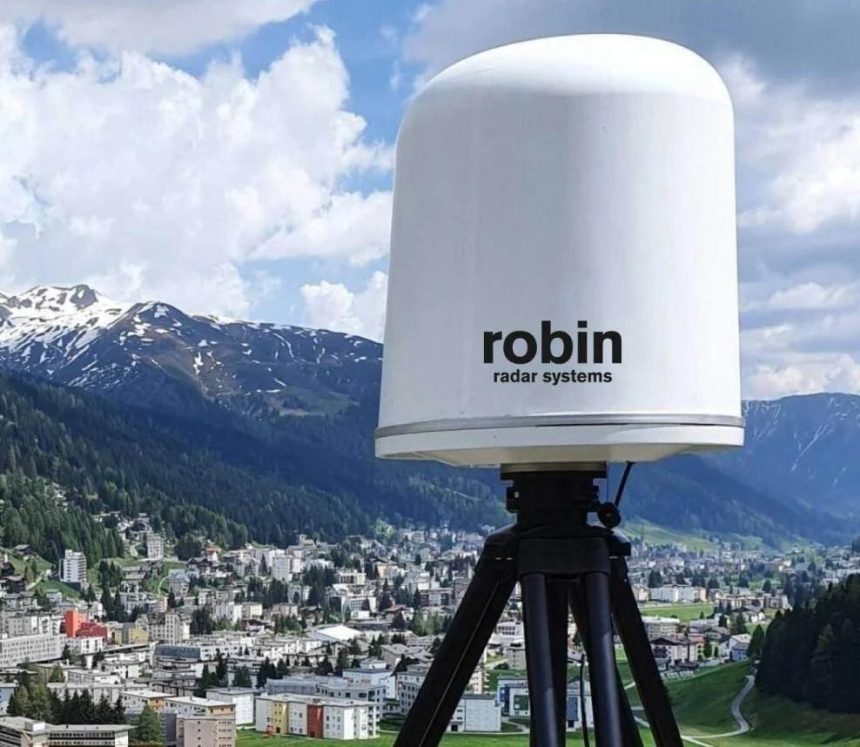
Robin Radar recently announced that the U.S. Department of Homeland Security (DHS) plans to deploy The Hague-based company’s IRIS drone-detection radar as part of DHS’s comprehensive suite of counter-UAS technologies designed to protect U.S. cities hosting the FIFA World Cup, set to begin in June.
“We see ourselves as an important building block in an overall detection system,” Marcel Verdonk, Robin Radar chief commercial officer, said in an interview with DroneLife. “A sports event or any large event provides fertile grounds for potential troublemakers who think that drones are a good way to disturb something, or worse case, to stage some terrorist activities.”
The IRIS system, a compact “plug-and-play” radar system, is expected to be deployed to fill the gaps at multiple venues where the use of more complex and expensive detection systems would not be appropriate. The system “can be set up in under 15 minutes by a single operator without technical support and operates 24/7 seamlessly with minimal human input,” according to the company’s press statement.
“Unlike more complex military systems that require teams of engineers to deploy and operate, the IRIS radar integrates seamlessly into broader counter-UAS architectures alongside cameras, acoustic sensors, passive-detection systems and command-and-control platforms.”
The FIFA World Cup events are not the first deployment of Robin Radar’s technology at major international sports venues. Verdonk said that French security forces deployed the company’s radars at the Paris Olympic Games in 2024, where IRIS was integrated into a multi-sensor security framework protecting athletes and spectators.
Verdonk said Robin’s systems are adept at detecting small flying objects such as drones and birds, at relatively short distances, about five to 10 kilometers (about three to six miles). The 15-year-old company’s first major project, launched at the behest of the Dutch Air Force, was to design a radar system to detect birds that were interfering with military take-offs and landings.
Several years into the bird-detection projects, “they figured out we were also pretty good at detecting drones,” he said.
“We then developed the first dedicated drone-detection radar. And now, in 2026 we have a second-generation of drone-detection radar,” Verdonk said.
The IRIS system uses a micro-Doppler technology that allows it to detect small movements on a flying object, such as the rotations of a drone’s propellers. “We detect that moving propeller and we can clearly say, ‘Hey, this object, it’s not a bird, but it’s a drone.’”
Verdonk said DHS selected Robin as one of its vendors for counter-UAS technology after a several years-long testing process. “They did many field tests with our radars and we passed the test and they picked us as one of the technologies that can help them with this event,” he said.
He added that he does not know for certain which World Cup venues would use the Robin technology, but said he believes that DHS might deploy the equipment at sites in Florida and Kansas City.
“The federal government in the U.S. typically has a few federally approved reselling companies, and they have been tasked by DHS to buy radars from us. They also buy equipment from other companies and they bring it all together and then work with DHS to roll it out to the different venues,” he said.
IRIS is rated as a Technology Readiness Level 9 (TRL 9) system, meaning it has been used extensively in active conflict environments, providing operational validation in high-pressure settings.
The IRIS is designed to provide 360-degree situational awareness, detecting, tracking and classifying airborne objects, including drones deliberately designed to evade traditional detection methods. “With an instrumented range of up to 12 kilometers (about 7.5 miles), IRIS offers early warning, giving authorities the time and space required to assess threats, coordinate responses, and act decisively,” the company statement says.
Verdonk said Robin started out providing radar systems to civilian security agencies and has since broadened its customer base to include national governmental agencies in North America and in its native Europe.
“Our radar was meant for policing, for prisons, for protecting World Cup stadiums and Olympic stadiums and critical government buildings. That’s still a big part of our business,” he said. Its customers have included the national prison system in The Netherlands and the Dutch National Police Corps, as well as police agencies in Germany and the UK.
“In more recent years we engaged with our own government and some other European governments to provide radars for the Ukraine conflict. The Ukrainians need to detect a lot of drones every day,” he said.
The war in Ukraine has served as warning to governments in Europe as well as in North America, on the need to develop robust counter-UAS capabilities on the national level, Verdonk said.
“They’re waking up and they’re realizing that obviously what’s happening on TV in the Ukraine is just essentially a drone war.”
Read more: Jim Magill is a Houston-based writer with almost a quarter-century of experience covering technical and economic developments in the oil and gas industry. After retiring in December 2019 as a senior editor with S&P Global Platts, Jim began writing about emerging technologies, such as artificial intelligence, robots and drones, and the ways in which they’re contributing to our society. In addition to DroneLife, Jim is a contributor to Forbes.com and his work has appeared in the Houston Chronicle, U.S. News & World Report, and Unmanned Systems, a publication of the Association for Unmanned Vehicle Systems International.
Filed Under: Anti-drone technology, C-UAS, DL Exclusive, Drone News, Drone News Feeds, Dual Use, News
Your email address will not be published.
Near Earth Autonomy and collaborators complete integration milestones for the RUC-60 optionally crewed Black Hawk ahead of mission testing in…
Continue Reading Autonomous Black Hawk Program Advances Toward Contested Logistics Missions
On this episode of the Drone Radio Show: Federico Borsari, Non-Resident Fellow with the Center for European Policy Analysis, talks…
Continue Reading Drones in the Arctic: Federico Borsari on Security, Surveillance, and NATO’s Strategic Frontier
Expanded ESC and power management lineup supports growing demand for integrated propulsion systems across uncrewed platforms Electric propulsion developer ePropelled…
Continue Reading ePropelled Expands Electronic Propulsion Portfolio with New Motor Controllers and Intelligent Power Systems
New manufacturing site expands domestic supply of plug-and-play counter-UAS technology for U.S. defense and security partners MyDefence has opened a…
Continue Reading MyDefence Opens U.S. Counter-Drone Production Facility in Oklahoma City
(Editor’s note: This story is part of a series of reports on efforts to establish new counter-UAS protocols in the…
Continue Reading New York Preps Counter-UAS for FIFA
Kaizen Aerospace, a heavy-lift autonomous aerial systems company, has signed a Memorandum of Cooperation with Uzbekistan’s Ministry of Agriculture and…
Continue Reading Kaizen Signs Agricultural UAV Agreement with Uzbekistan
The FCC’s recent decision to prohibit new foreign-made drones and components marks a major shift in U.S. drone policy, aimed…
Continue Reading Mariah Scott on Building a Resilient US Drone Ecosystem
Galaxy 1 Communications has announced a partnership with Viasat to expand delivery of Velaris, Viasat’s dedicated satellite communications service for…
Continue Reading Galaxy 1 and Viasat Partner to Scale UAV Satellite Connectivity for BVLOS Operations
Bluffdale, UT-based defense company Vector has secured a $20 million loan from J.P. Morgan to expand domestic small unmanned aerial…
Continue Reading Vector Secures $20M J.P. Morgan Loan to Scale U.S. sUAS Manufacturing
Yes, we’re celebrating. It’s been more than 10 years since DRONELIFE started – and we’ve been growing ever since. It’s…
Continue Reading To Our Readers: We Appreciate You
SPONSORED
About Us | Contact Us | Advertise With Us | Write for Us | Privacy Policy | Terms of Service
The Trusted Source for the Business of Drones.
This website uses cookies and third party services. By clicking OK, you are agreeing to our privacy policy. ACCEPT