
The Lebanese army defused on Sunday tensions in the northern city of Tripoli sparked by the clashes along the Syrian coast.
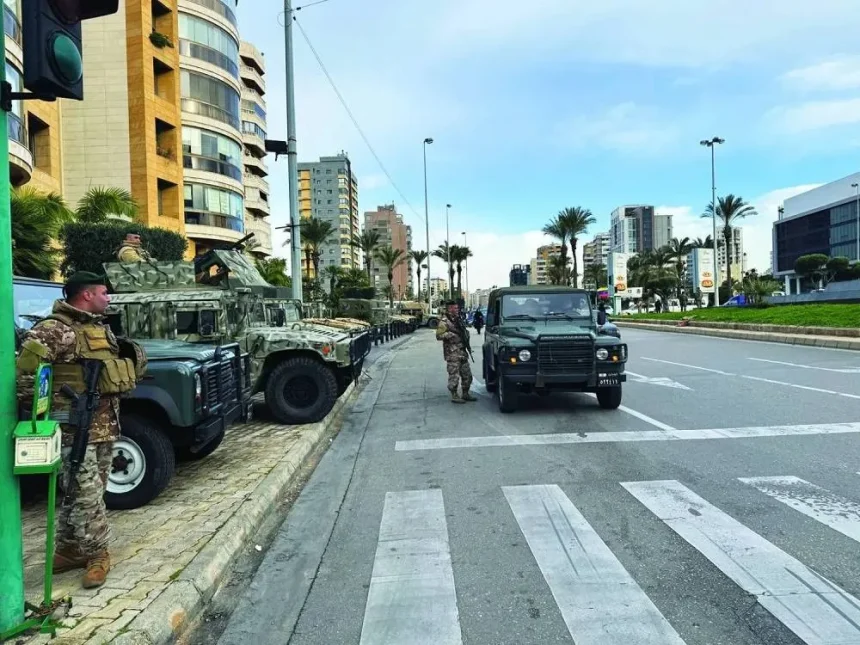
The army deployed in areas separating Sunni and Alawite neighborhoods in Tripoli overnight on Friday to contain any tensions from the violence in neighboring Syria.
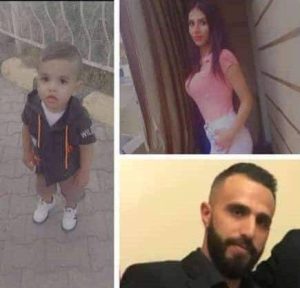
Angry protesters had taken to the streets of Tripoli after news broke out over the stabbing of a minor from Syria’s Idlib. .
Soon after, news circulated on social media that Ahmed Bitar, a man from the predominantly Alawite neighborhood of Jabal Mohsen in Tripoli, was behind the attack.
The protesters blocked the Baqqar road leading to Jabal Mohsen, while tensions were high in the Qobbeh neighborhood, as the people called for the arrest of the perpetrator.
The tensions boiled over into a gunfight, sparking panic among the people. The army soon deployed heavily in the area and restored calm.
The Supreme Alawite Council warned in a statement that “civil peace and security stability were a red line.” It revealed that Bitar had complied with calls to turn himself over to the authorities.
“We fully trust that the security forces will carry out their duties to reveal the circumstances of the crime and uncover the truth,” it said.
“Tripoli has been and will continue to be a model of national unity that will shun strife,” it added.
A security source told Asharq Al-Awsat that the tensions in Tripoli were stoked by social media posts. No foreign meddling or political incitement were behind them.
The army moved quickly to contain the tensions, deploying heavily in Tripoli. Sunni and Alawite figures in the city were contacted to help defuse the tensions and prevent the unrest in Syria from spilling over into Lebanon.
Meanwhile, hundreds of Syrian Alawites sought refuge in northern Lebanon to escape the violence along the coast.
Security sources told Asharq Al-Awsat that the Syrians were entering through illegal crossings and heading to predominantly Alawite villages or Jabal Mohsen.
No exact figures have been tallied because the people are entering through illegal crossings, they added.
Media reports and local sources have said over 10,000 people have entered from Syria in the past three days.
Lebanese Prime Minister Nawaf Salam warned on Friday that “a humanitarian disaster is looming” as a result of Israeli evacuation orders that are causing a massive displacement of the population.
“The humanitarian and political consequences of this displacement could be unprecedented,” the premier told foreign ambassadors.
Residents of the southern suburbs of Beirut and of the south of the country, both Hezbollah strongholds, have fled in large numbers following unprecedentedly wide evacuation orders from the Israeli military.
Lebanese officials and Syrian authorities have sought to calm concerns over recent Syrian troop deployments along the Lebanese border, stressing that the movements are defensive and not directed at Lebanon.
A Lebanese official source said the reinforcements sent by Damascus are “intended to protect Syria, not to attack Lebanon,” noting that coordination is ongoing between the Lebanese and Syrian armies.
According to the source, Syrian officials reassured Beirut that the deployments are part of broader measures covering Syria’s borders with both Lebanon and Iraq. The steps are described as precautionary aimed at tightening border control and strengthening security amid regional developments and a rise in smuggling attempts.
Concerns had mounted among some Lebanese, particularly on social media, that the Syrian military buildup could signal preparations for operations in eastern Lebanon. The Lebanese Armed Forces moved to dispel those fears earlier this week.
In a statement issued Wednesday, the army said its units had “reinforced their deployment along the eastern border, in coordination with the relevant Syrian authorities.”
Lebanese Prime Minister Nawaf Salam also addressed the issue during a Cabinet session on Thursday. He said he had received a call two days earlier from Syrian Foreign Minister Asaad al-Shaibani, who explained that the deployments were aimed at strengthening border control and maintaining Syria’s internal security.
Salam added that the Syrian chargé d’affaires in Beirut visited him the same day to deliver the same message, noting that the measures mirror steps taken along Syria’s border with Iraq.
“Both Syrian officials stressed their country’s commitment to maintaining the best possible relations with Lebanon,” Salam said, adding that Lebanon seeks to build a new relationship with Syria based on mutual trust and non-interference in internal affairs.
He also urged caution regarding misleading reports circulating online, saying such claims are intended to spread fear and distract from the country’s real challenges.
Syrian clarification
The Syrian Ministry of Defense also issued a statement emphasizing that the activity along the Lebanese border is an “organizational deployment of forces” as part of monitoring and control procedures, not a military escalation or action against any party.
The ministry said the move falls within the Syrian army’s responsibility to protect the country’s international borders and prevent illegal activities.
According to the ministry, border guard units supported by reconnaissance battalions are conducting patrols, monitoring the frontier, and regulating movement at official crossings and informal routes.
Deployment along the east
Local sources in Lebanon’s Bekaa region reported that Syrian forces have deployed along a wide stretch of the border, from the areas south of the Masnaa crossing to Masharii al-Qaa in northeastern Lebanon.
The reinforcements cover areas opposite the outskirts of Arsal, Ras Baalbek, and Qaa, east of Hermel in northern Bekaa.
Sources told Asharq Al-Awsat that some of the fighters stationed on the Syrian side include Uyghurs and Chechens, as well as brigades transferred from Idlib, raising concerns among residents on the Lebanese side of the border.
A Lebanese source, however, reiterated that the troop buildup is not aimed at Lebanon and should be understood as part of Syria’s internal security measures.
At the same time, border crossings between Lebanon and Syria have seen increased activity as Syrian nationals return home from Lebanon.
Between 450 and 500 people cross daily into Syria through the Qaa and Masnaa crossings, while authorities estimate that roughly three times that number leave through informal crossing points in northern Lebanon and the Bekaa Valley.
Lebanon’s General Security Directorate has facilitated the return of Syrians to their country, while the northern crossings at Arida and Aboudieh remain closed.
The Israeli military said on Friday it had hit a Hezbollah command center and drone depot in a “broad-scale wave of strikes” overnight in Beirut’s southern suburbs.
The strikes came after the Israeli army issued an evacuation warning for the area, home to hundreds of thousands of people and a stronghold of the Iran-backed Hezbollah, sending residents fleeing in panic.
“As part of the strikes, an executive council’s command center and a facility storing UAVs (drones) utilized by Hezbollah for conducting attacks against the State of Israel were struck,” the Israeli military said in a statement.
Lebanon was dragged into the war on Monday, when armed group Hezbollah attacked Israel to avenge the killing of Iranian supreme leader Ali Khamenei in the US-Israeli strikes that launched the war.
Overall, the Israeli army said it had carried out 26 waves of strikes in the suburbs, known as Dahieh, since the start of its campaign in the country this week.
Lebanon’s health ministry said on Thursday that 123 people had been killed and 683 wounded in the Israeli strikes across the country.
انشئ حساباً خاصاً بك لتحصل على أخبار مخصصة لك ولتتمتع بخاصية حفظ المقالات وتتلقى نشراتنا البريدية المتنوعة
Army Defuses Tensions in Northern Lebanon Caused by Syrian Coast Unrest – Asharq Al-awsat – English



Leave a Comment