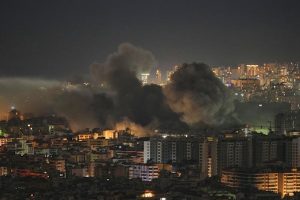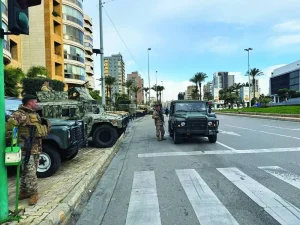


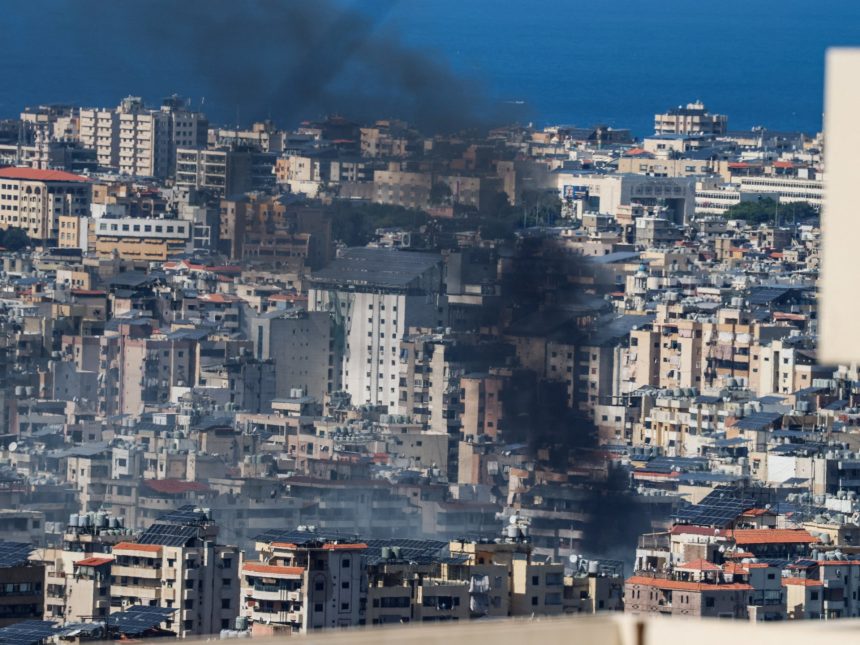
Israeli forces pound Beirut’s southern suburbs as ground troops continue to push deeper into Lebanon.
Share
Save
Israeli strikes have hit the southern suburbs of the Lebanese capital, Beirut, state-run media say, while 10 people are reported killed across the country as Israel’s deadline for Iranian officials to leave Lebanon expires amid a wider regional war.
The Lebanese National News Agency (NNA) on Thursday reported several strikes in the early morning on the Beirut suburbs of Ghobeiry and Haret Hreik. There were no immediate reports of casualties.
Israel’s military had earlier issued forced displacement orders for the suburbs where the strikes were reported, warning it was about to hit what it said were targets linked to Hezbollah.
It said the targets included a facility used by the group’s aerial units but did not provide evidence.
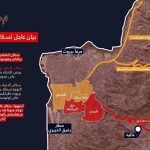
An Israeli army Arabic spokesperson, Ella Waweya, issued new forced displacement orders on Thursday afternoon for the entirety of several southern suburbs, namely Burj al-Barajneh, Hadath, Haret Hreik and Chiyah.
Waweya said residents must immediately flee their homes to “save their lives”.
Al Jazeera’s Bernard Smith, reporting from Beirut, said the forced evacuation order covered all of the southern suburbs of Beirut, known as the Dahiyeh area.
“We’re talking about an area, according to the latest estimates, with some 400,000 people. I understand that the Israeli army has never before issued an evacuation order for this area,” Smith said.
“There’s been a lot of gunfire in the last 10 minutes or so. That is sort of a warning by the forces in control here to tell people they need to evacuate.”
“This, with the incessant noise of an Israeli drone overhead, is bringing the fight that Israel has with Hezbollah much closer to the centre of Beirut,” Smith said.
Israel on Wednesday gave Iran’s representatives in Lebanon 24 hours to leave the country. That deadline has since expired.
Al Jazeera’s Heidi Pett, reporting from Beirut, said: “The Iranians seem to believe that this is a threat against their embassy and are threatening any Israeli embassy if their mission is struck.”
Human Rights Watch called the threats deeply concerning, saying they signal an intent to commit a war crime as people who are not directly involved in hostilities cannot be targeted under international law.
Prime Minister Nawaf Salam and Information Minister Paul Morcos stated after a government meeting on Thursday that they had requested “all necessary measures be taken to prevent any military or security activity by members of the Iranian Revolutionary Guard in Lebanon, as a prelude to their deportation”.
They also rejected Hezbollah’s accusations that the government was aligning itself with Israeli demands, saying that those committing “a sin” were those endangering Lebanon.
This comes after Salam’s cabinet on Monday announced a ban on Hezbollah’s military and security activities.
In southern Lebanon, Israeli attacks have killed six people, including four members of one family, the NNA reported.
In a village near Kfar Tebnit, two children and their parents were killed while another attack in the Nabatieh region killed the mayor of a village and his wife.
Israeli strikes were also reported in the al-Shahabiya district of Tyre.
Hezbollah on Wednesday said its fighters were engaged in armed confrontations with advancing Israeli forces in the town of Dahira in the far south of Lebanon. The group has also been carrying out air attacks in northern Israel.
The fighting was reported as Israeli troops continued to push deeper into Lebanon in a ground offensive north of the Israeli-Lebanese border with the declared intent of creating a buffer zone and pushing back Hezbollah.
The Israeli army on Thursday issued another evacuation threat for residents of southern Lebanon, warning them to “continue evacuating to the north of the Litani River”.
“Anyone present near Hezbollah elements, facilities, or combat means endangers their life,” it said. “Any home used by Hezbollah for military purposes may be subject to targeting.”
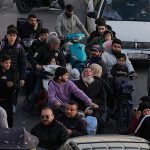
More than 300,000 Lebanese have been displaced during the ongoing offensive, which began on Monday, according to the Israeli military.
An army spokesperson said Israel’s attacks had struck more than 320 locations in Lebanon, destroying targets that include missile launchers.
Hezbollah later said it attacked Israeli soldiers inside Lebanese territory, something the Israeli army has acknowledged while confirming that two soldiers were injured.
Al Jazeera’s Zeina Khodr, reporting from Beirut, said Hezbollah’s strategy appeared to be making the conflict and Israel’s advance in the south as costly as possible by firing missiles, rockets and drones across the border.
“Meanwhile, the Lebanese government is simply too weak to influence the situation,” she said. “The Lebanese army has been forced to pull back from the border, and the government has taken the unprecedented step of banning Hezbollah’s military wing.”
“However, that is about as far as it can go without risking internal strife in the country,” Khodr added.
In eastern Lebanon, an Israeli attack targeting a car on a highway near the town of Zahle killed two people and injured two more.
A strike was also reported in northern Lebanon in the Beddawi refugee camp, close to the city of Tripoli, far from where the majority of Israeli attacks on Lebanon have taken place.
Lebanon’s Ministry of Public Health said the attack killed at least two people.
Local sources in the Palestinian refugee camp told Al Jazeera a Hamas official was killed in the attack, which appeared to be a targeted assassination.
At least 75 people have already been killed in Israeli attacks in Lebanon since Monday with more than 400 wounded.
Israeli forces on Wednesday bombed the Comfort Hotel on the border of Hazmieh and Baabda, which are part of greater Beirut. An Israeli strike in Baalbek, close to the Syrian border, killed at least five people.
Follow Al Jazeera English: