
Personalise the news and
stay in the know
Emergency
Backstory
Newsletters
中文新闻
BERITA BAHASA INDONESIA
TOK PISIN
Topic:War
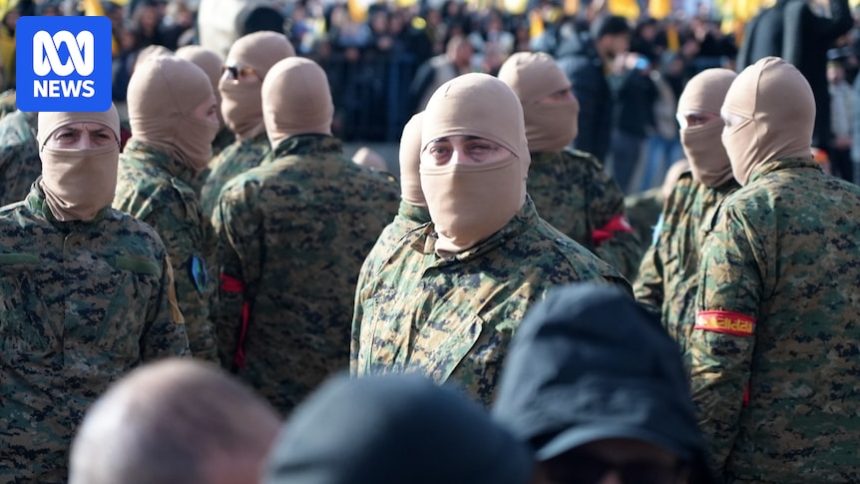
Lebanon's government has warned Hezbollah militants to surrender their weapons. (ABC News: Cherine Yazbeck)
Hadi Mourad is sitting in a car in Beirut, shouting at his phone.
"You are liars, you are frauds," he rails in the video, which has gone viral online. "God's curse upon you. You're criminals under the banner of God."
Mr Mourad, a Lebanese political analyst and doctor, is ranting about Hezbollah. And he's not alone.
These days, finding criticisms of the Islamist militant group and political party — an organisation once seemingly untouchable — is much easier than it used to be.
Hezbollah's decision to join the war in the Middle East this week has been described as "suicidal".
Many experts say whatever happens next will dramatically shape Lebanon's future.
Hadi Mourad is among those who aren't mincing their words when it comes to Hezbollah. (X: @hadimourad1)
Hezbollah has been a force in the country's politics and society for more than four decades. Israel is its avowed enemy.
It represents Shia Muslims, a sect often marginalised globally, but one which makes up more than 30 per cent of Lebanon's population.
Hezbollah is largely funded and directed by Iran's strict theocratic Islamist regime — who are also Shias — and has been designated as a terrorist organisation by the Australian government.
The group controls large parts of Lebanon. These areas function as states within a state. Inside, Hezbollah runs everything from education and healthcare to security affairs.
Many Shias believe this system works for them. Without Hezbollah, some say, they would be left behind by a state, struggling economically, that cannot afford to provide.
In conflict-weary Lebanon, however, Hezbollah's decision to join the war in the Middle East this week has been widely condemned: by the government, by the military, by the influential Christian community — which makes up more than a third of the population — and even by some Shias.
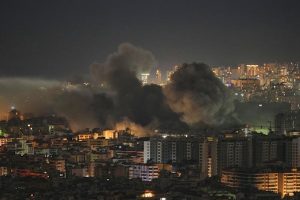
Hezbollah attacks on Israel, which began Monday, have sparked a fierce response, with the Israel Defense Forces (IDF) unleashing days of air strikes and a ground invasion expected to continue for months.
Already this week, thousands of Lebanese have arrived at the country's border with Syria, trying to cross as the situation escalates.
Israel's air strikes have been pounding Hezbollah's strongholds in southern Beirut. (Reuters: Ahmad Al Kerdi)
Mohamad Hussein Faani is among the Shias criticising Hezbollah. The father-of-two from Taloussa, a village in southern Lebanon, had to evacuate from his home earlier this week.
Israel has been bombarding areas like his. Mr Faani has no idea if his house is still standing. But he blames Hezbollah for his situation, not the IDF.
"I will say this honestly and courageously: I don't believe Hezbollah should have entered this fight at all," he told the ABC from the school in Beirut, Lebanon's capital, where he's sheltering with his wife and children.
As he spoke, a crowd gathered around. Some people heckled him and warned him not to speak ill of the militant group. Historically, speaking out has carried harsh consequences.
"I'm Shia. But I am critical," Mr Faani said. "I'm critical of this entire situation. Because morally, this is not who we are. Lebanon has always been a civilisation of culture. A school of ethics. A country that sought to spare bloodshed."
Mohamad Faani is among the Shia community who are fed up with Hezbollah. (ABC News: Cherine Yazbeck)
Lebanon's complex political system shares power along sectarian lines. Here, religion is entwined with government.
The country has fought multiple wars with Israel in the past and the two still have no formal diplomatic relations.
But these days, opposition to Lebanon's southern neighbour has been spearheaded by Hezbollah, not the government in Beirut.
While Israel is still seen by most Lebanese as their country's primary enemy, frustration and anger with Hezbollah is growing.
Critics say Hezbollah does what Iran wants, not what is best for Lebanon or even Shias in the country.
That changing sentiment has manifested in multiple ways this week, including people challenging the militant group openly, something seldom seen previously.
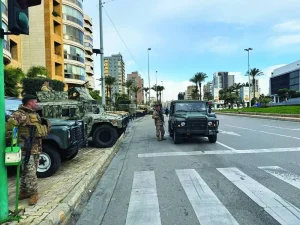
A Lebanese official walks past Shia refugees in central Beirut this week. (ABC News: Cherine Yazbeck)
On Wednesday, local time, Lebanese president Joseph Aoun appeared in a military uniform and made it clear he was fed up.
"I want everyone to understand, that the decision to ban any military activity of Hezbollah or affiliated elements [has been made] and anyone who violates this decision is breaking the law," he said, adding those who did would be arrested.
"No-one is above the law, and no-one is greater than their country."
Mr Aoun was not lying: the Lebanese army has so far confirmed it has detained dozens of Hezbollah fighters for illegally possessing weapons.
His broadside came after Prime Minister Nawaf Salam, a Sunni Muslim, announced a "ban on Hezbollah's military activities" on Monday and renewed demands for the group to disarm.
An Israeli tank rolls over the border and into southern Lebanon on Thursday. (Reuters: Ammar Awad)
But the opposition is not just coming from government and military officials.
Israel has also played a role. There have been reports Mohammad Raad, the head of Hezbollah's bloc in the Lebanese parliament, was targeted in an IDF air strike on southern Beirut on Monday.
In the days since, videos of Hezbollah supporters being verbally or physically attacked in Lebanon have emerged online.
In one, a man who showed a picture of the militant group's former long-time leader, Hassan Nasrallah, inside a barber shop, was beaten up.
As people flee Hezbollah-controlled southern Lebanon for the relative safety of other areas, businesses have begun turning displaced Shias away, arguing it's too dangerous to accommodate them.
Girls show off a picture of Hassan Nasrallah at his funeral in 2024. (ABC News: Cherine Yazbeck)
Alain Chebli owns a hotel in a Christian neighbourhood of Beirut that has been spared from IDF attacks over the past three years of war.
He had been among those bucking that trend and opening his door to people from the south.
"We received mostly elderly people and families with small children," Mr Chebli said. "We took in as many as we could. We tried to maintain control [of who was staying], registering families, taking names and ID cards."
Now, he thinks doing so made his hotel — which was bombed by Israel's military early Wednesday morning — a target. Could Hezbollah operatives have been among his guests?
"You can take someone's ID, but you don't know their work, their background, what they actually do," Mr Chebli said.
Alain Chebli had been taking in Shia refugees. (ABC News: Cherine Yazbeck)
Hezbollah and Israel have been fighting for much of the past three years, although a tenuous ceasefire was in place until this week.
Over that time, the militant group's capacity has been severely degraded.
The IDF has killed dozens of Hezbollah leadership figures, along with thousands of its fighters and much of its munitions stockpile. The group's funding and supply lines, which once flowed freely from Tehran through Syria, have been cut.
"The Shia made a suicidal move by attacking Israel," said Brigadier General Maroun Hitti, a veteran of the Lebanese army and former government military advisor.
He argues Hezbollah could cease to exist in a meaningful way after this latest war is over.
"When two armies are of equal strength, the outcome is left to chance and circumstance," he said. "When there is a vast imbalance in power, we already know the result."
Naim Qassem makes a point during a televised address earlier this year. (Supplied: Al Manar TV via Reuters)
Hezbollah leader Naim Qassem, defiant, described the group's current fight as "existential" in a televised address on Wednesday night.
"We are facing aggression … our choice is to confront it until the ultimate sacrifice, and we will not surrender," he said.
But as tanks continue to rumble over the border, most of the anger in Lebanon right now appears to be directed at Hezbollah, not the IDF.
Israeli Prime Minister Benjamin Netanyahu said on Tuesday his country's military would "respond with great force" against the militant group and that "the people of Lebanon must understand Hezbollah is dragging them into a war that is not theirs".
For the first time — perhaps ever — the governments of Lebanon and Israel appear to have one common enemy.
Topic:War
LIVE
Topic:War
Analysis by Ian Verrender
Topic:Floods
Topic:Explainer
Topic:Federal Government
Lebanon
War
Topic:War
LIVE
Topic:War
Analysis by Ian Verrender
Topic:Floods
Topic:War
Topic:Child Sexual Abuse
Topic:World Politics
Topic:Floods
Your home of Australian stories, conversations and events that shape our nation.
This service may include material from Agence France-Presse (AFP), APTN, Reuters, AAP, CNN and the BBC World Service which is copyright and cannot be reproduced.
We acknowledge Aboriginal and Torres Strait Islander peoples as the First Australians and Traditional Custodians of the lands where we live, learn, and work.
Sign up to get the latest on your favourite topics from the ABC
'You are liars, you are frauds': Hezbollah faces reckoning in Lebanon – Australian Broadcasting Corporation


Leave a Comment